Do You Know What Juneteenth Is?
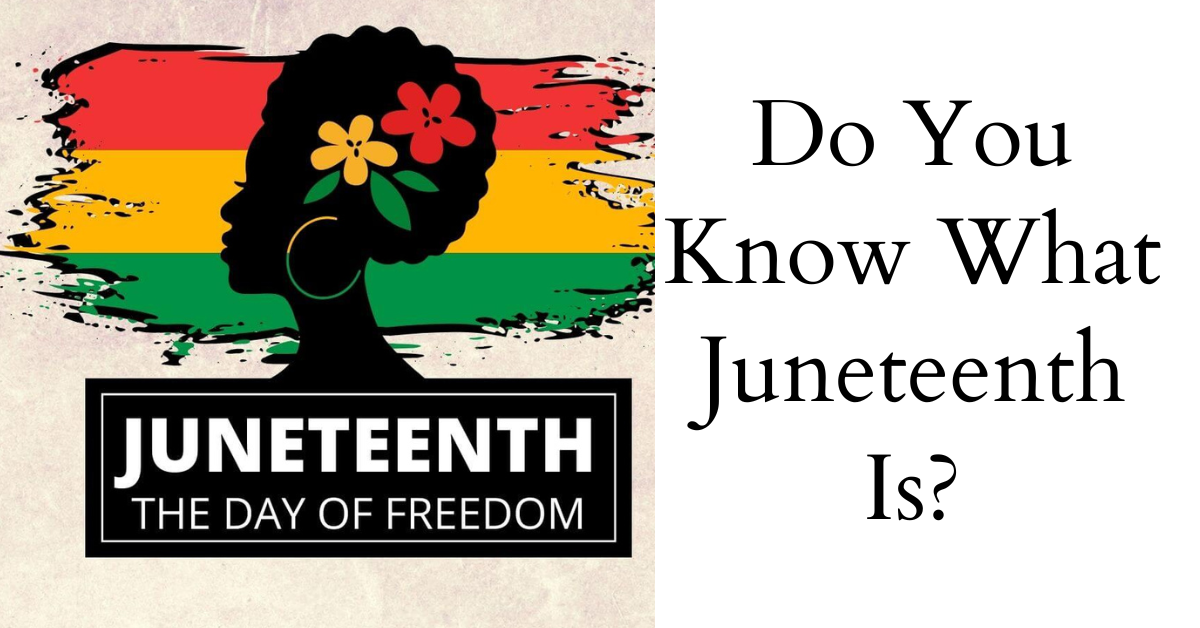
Juneteenth National Independence Day commemorates the end of slavery in the United States. It is celebrated annually on June 19th. Due to poor education on Black History in the United States, you might not actually know anything about it.
Marking The End of Slavery
On June 19, 1865, at the end of the civil war, General Gordon Granger ordered Texas to put an end to slavery according to President Abraham Lincoln's 1863 executive order, the Emancipation Proclamation.
In January of 1865, congress proposed the 13th Amendment to the constitution of the United States to abolish slavary and by June almost all of the slaves had been freed by the Union Army or state abolition laws.
But not all were 100% free until the amendment was ratified in December of that year and the remaining slaves in Delaware and Kentucky were finally set free.
June 19, 1865 marked 900 days from when the Emancipation Proclamation went into affect and 24 days after the disbanding of the Confederate military department covering Texas.
Despite Robert E. Lee surrendering on April 9, 1865, the Western Confederate Army of the Trans-Mississippi did not formally surrender until June 2. And on June 19, Union Major General Gordon Granger arrived on the island of Galveston and took command of more than 2,000 federal troops that had landed there to enforce Texas's freeing of the slaves.
The Beginning of Juneteenth Celebrations
Juneteenth celebrations started exactly one year later on June 19, 1866 and became annual commemorations of "Jubilee Day". These early celebrations were used as political rallies, though in some cities, Black people were barred from using public parks due to state-sponsored segregation. Which was a way to continue to control the newly freed slaves.
Black people pooled their funds to purchase land to hold their celebrations. The day was first celebrated in Austin in 1867 and was listed in the "calendar of public events" by 1872. That year, Black leaders in Texas raised $1,000 for the purchase of 10 acres of land. Today, that land is known as Houston's Emancipation Park. They used this land to celebrate Juneteenth.
In 1898 an estimated 30,000 Black people celebrated at Booker T. Washington Park.
Jim Crow Era Declined Celebrations
During the horrible Jim Crow era in the United States, Juneteenth Celebrations saw a decline.
Gladys Knight wrote about the decline in celebration partially due to "upwardly mobile blacks... were ashamed of their slave past and aspired to assimilate into mainstream culture. Younger generations of blacks, becoming further removed from slavery were occupied with school... and other pursuits."
The Great Depression forced many Black people off farms and into cities for work and were unable to take the day off to celebrate.
From 1936 to 1951, the Texas State Fair served as a destination for celebrating and contributed to its revival. It's estimated that in 1936, 150,000-200,000 people joined together to celebrate the holiday in Texas.
In 1938, the Governor of Texas, James V. Allred proclaimed June 20, 1938 as a day for observance of EMANCIPATION DAY as the 19th fell on a Sunday that year.
1940-1970 was considered the "Great Migration" when more than five million black people left Texas, Louisiana, and other parts of the South to head to the North and West Coast and they brought their Juneteenth celebrations with them. Juneteenth was introduced in San Francisco in 1945 by Wesley Johnson who had left Texas for the West Coast.
Celebrations Revived
In the 1960's-1980's Juneteenth saw a revival in celebrations. Large celebrations were held in Minneapolis, Milwaukee and across the eastern United States. In 1974 Houston started holding large-scale celebrations again, and in Fort Worth, Texas in 1975, around 30,000 people attended festivities in Sycamore Park.
In 1979, Texas Legislature made Juneteenth a state holiday. Marking the first state to do so. Democratic State Representative Al Edwards of Houston, successfully sponsored legislation to make it a paid state holiday. The same year he hosted the inaugural Al Edwards prayer breakfast and commemorative celebration on the grounds of the 1859 home, Ashton Villa, that is popular in legend as the location of Major General Granger's order. Edwards's annual celebration includes a local historian dressed as the Union general reading the order from the second story balcony. The Emancipation Proclamation is also read and speeches are given.
After his death on April, 29, 2020 his son has continued to hold his celebations.
Continuing The Fight For Recognition
In 1999 Ralph Ellison's novel, Juneteenth was posthumously published. (In 1965 an excerpt was published in Quarterly Review of Literature where it gained some popularity.) This increased the recognition.
By 2006, at least 200 cities across the U.S. had celebrations to mark the day.
It gained more popularity when Juneteenth was in an episode of Atlanta in 2016, and Black-ish in 2017. Black-ish's episode featured music about the holiday by Aloe Blacc, The Roots, and Fonzworth Bentley.
In 2018, Apple added Juneteenth to its calendar's under official U.S. holiday's, some companies began to adopt it as a paid day off for employees, and some marked the day in ceremonial ways like holding a moment of silence. 2020 was an even bigger year for the holiday as the NFL and Nike began treating it as a company holiday and Google added it to their calendar. A number of universities also formally recognized it as a "day of reflection" or a university holiday.
A mother-daughter film was released in 2020 about the holiday's pageant culture titled, Miss Juneteenth. It featured black women who were determined to stand on their own and confront the sexism in their communities.
By 2016, 45 states were recognizing the occasion. Activist Opal Lee (known as the "Grandmother of Juneteenth), began a symbolic journey where she walked from Fort Worth, Texas to Washington D.C. to advocate for making Juneteenth a federal holiday
It wasn't until June 17, 2021 that President Joe Biden made it an official federal holiday.
In conclusion, Juneteenth marks the day when the slaves were freed in Texas and its federal recognition as a holiday was long overdue. While Joe Biden was good for making it an official federal holiday, I think it should have been recognized as one on June 19, 1865.
Black people's history is often overlooked (and under-taught) in the United States and it's terrible because they have suffered so much. Racism still exists here today and I think it's safe to say that it's more rampant than it was 10 years ago. White people have a duty to unlearn everything we've been taught and to learn the real history of Black people in this country.
Donating to the NAACP is just a small part of what can be done for activism today.
The freedom to vote is the foundation of our democracy. Yet across the country, efforts to weaken fair representation and limit access to the ballot threaten the voices of millions. Your donation helps NAACP fight for equal political participation, defend voting rights, and ensure every community has a fair say in the decisions that shape our future.
Comments ()